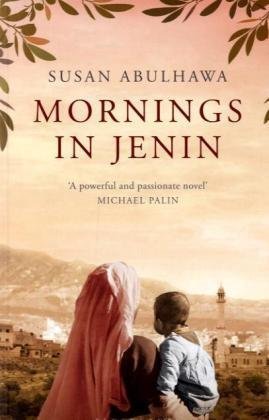
I love this novel, it is not modern , nor postmodern although it's written in the early 21st C, I think it's one of the reasons for me to love it. Instead of trying to create a new artistic prose and format, the author, Susan Abulhawa, has something to tell. A story. A story which grows almost organically out of historical events which occured in the early 1940's up to now in the British protectorate Palestine, Israel, Jordan and the West Bank.
There are so many features in this novel that render it the epithet masterpiece; it is clearly a call for compassion with the arabs in Palestine against the Israeli violence and still one of the families that we get to know in the book is jewish, belonging to the group of jews that fled Europe just before the holocaust. Another one is the love story between the daughter-in-law, Dalia, and her mother - in -law, Basima, who at first was against the marriage between her son and the bedouine girl, yet takes her to her heart, as if she was the daughter she never got herself, after getting to know her. Another is the story about Darweesh and his beautiful stallion Ganoosh.
The novel consists of these mini-portraits of villagers spread around the world. The assorted portraits give the novel a resemblance to a great French 19th C novel such as Germinal by Zola or any work by Balzac.To the great shame of European culture we are not used to reading these kind of novels about people outside Europe. We see novels like Mornings in Jenin as something new and thus interesting. Of course 19th C novels have to be written about others too, Europeans are not the only persons who got stories to tell. Terefore Mornings in Jenin is not interesteing because of the novelty of it, because there is nothing modern about it, it is interesting exactly in the same way as Crime and Punishment, Les Miserables or Middlemarch is interesting; it has a great story to tell about real human beings.
You might criticize Mornings in Jenin for being biased for the Palestinian arabs and against jews in general and Isreli jews in particular. For instance it once claims thet the 6-day war started by Israeli forces attacking Egypt. However, this is the story told from the perspective of a child that survived, a child that got all her news from highly biased media, it is not a history book, it is a story about real human beings, a human tragedy striking innocent people who are used for other's benefit in many ways. It's claims are not historic accuracy but humanitarian accuracy and in this it is a great success.
I have met people that, thanks to Mornings in Jenin has understood the complexity and gravity of the conflict in the Middle East. Like the Diary of Anne Frank's brought us to understand that behind the monstrous figures of millions and millions perishing in the Holocaust are real human beings like you and me, Mornings in Jenin give voice and face to those who suffered and suffers from the clearing of Israeli land to let jews take over what arabs had built up during centuries. This novel let us know that behind the figures of hundred thousands of Palestinians living in refugee camps for generations there are persons, real human beings, with voices and wishes, hopes and dreams.
This truth becomes extra visible by showing us the joys of the refugees from Ein Hoda, we are all too familiar with the sorrows of them. Such as the trip back to the village of grandpa to harvest his own gardens or the mornings which Amal spent with her father reading and discussing, listening to him reciting poems by Gibran or when Huda and Amal painted their finger and toe nails with red nail polish one week before the war.
In search of the human good of Dorothea Brooke, Mornings in Jenin gives us clues to and maps out a possible way to reach there. The novel certainly is biased and lacks the complexity of a novel by Tolstoy, where you never really manages to pin point who are the good guys and who are the bad ones, but it gives you an understanding of the human mind, the ugliness of war and the beauty of what people can do to relief suffering of others despite ethnical barriers raised between them by people with more power than heart. Read it!

