Visar inlägg med etikett love. Visa alla inlägg

torsdag 5 november 2015

The Notebook

New Bern, I imagine Noah's house like this.
New Bern, a small Southern town on the river Neuse remains the lasting impression of the cute love story told by Nicholas Sparks in his award winning novel The Notebook.  This doesn't indicate that the novel is disposable. On the contrary it is a small novel that grows from a rather ordinary romantic novel to something special in the end. You rarely follow the happy couple through all those years when they lived happily until death did them apart. In this novel you do, the end of life with all its trials and tribulations is in fact tying this story together which embraces a life time from 1935 up until the 1990's when the happily ever aftr comes to its tragic and tender end.

In the end Sparks examines the process of falling in love in a way which I have never seen it penetrated before. To be able to depict romantic love with old people as the main characters must be as easy as doing it with young people, and yet there are so few novels about mature love.  Why so many novels and stories about young love and so few about life long love? I guess someone out there thinks that we want to read about young love all the time. However, most readers are not extremely young today and I predict that more novels will deal with similar subjects as this one.

I also hope that more novels will deal with age and sickness even if they are written for a young audience. Right now my pupils aged 16 and 17 read The Notebook. I hope they will remember it and that they get tools to confront old age when it comes to them, 60 years from reading this at school. 

Back to New Bern, why was that such a lasting impression of this novel?  Simply because my picture of a small river town in North Carolina was very vague and with this novel I felt that I got to know it a little bit. The life on the river, water fowl and kayaking plays an important part in the story and suddenly, for the first time in my life I feel an urge to go to North Carolina. Don't worry, this too will pass. 

This song creates a sound track suitable to this saga of neverending courtship that begins and ends when the ever after part is almost over. In fact, the love story in The Notebook is exactly like this: "I don't know if the suns gonna shine and I don't know if you'll ever be mine, but I make love to you anytime"


fredag 24 februari 2012

God is love

Every now and then I need to watch and listen to this clip with Gungor. Sometimes life feels dull and then this clip reminds me of all wonderful reasons to live there are:


lördag 29 oktober 2011

La Princesse de Clèves, un roman de clés I: l'époque


L’époque où se déroule le récit du roman La princesse de Clèves par Madame de Lafayette est vers 1550 en France et le lieu est la cour d’Henri II, mais on fait aussi des excursions quand on écoute des conversations dans la cour d’Angleterre et l’Écosse. Henri VIII d’Angleterre et sa fille la Reine Élisabeth font partie du personnage secondaire avec la rivale et cousine d’Élisabeth, Marie Stuart.  L’Europe des années 1500 est une Europe déchirée des conflits des religions, ou plus précise, entre l’église catholique et les nouvelles églises protestantes.

L’essor du protestantisme en France est bien fort et Henri II le réprime plus que son père Henri I. La France est toujours en pleine guerre en Italie. Les guerres d’Italie, menées pour conquérir les royaumes de Naples et le duché de Milan, que les souverains français  estimaient comme des parties de la France légitimes. Pourtant le roman ne s’intéresse pas aux guerres de l’époque mais aux  des guerres du cœur en manifestant dans des intrigues de la cour. Les guerres sont seulement présentes comme la cause des cavaliers de faire ses adieux aux dames de la cour.

Henri II le Roi du roman
Diane de Poitiers, la duchesse Valentinois,
la maïtresse et amie d'Henri II
Cathérine de Médici la Reine du roman
et la femma d'Henri II

Cependant, l’histoire des cours en Europe de l’ouest pénètre le roman totalement, mais les premières pages sont totalement dédiées à la politique amoureuse de l’époque. L’amitié entre l’auteur, Mme Lafayette et la princesse Henriette d’Angleterre est probablement la cause de cette introduction au style du Seigneur des anneaux par J.R.R Tolkien. L’introduction était critiquée pour être ennuyeuse et probablement il y avaient des lecteurs pendant l’existence du roman qui avaient trouvé l’introduction de La princesse de Clèves  aussi ennuyeuse mais on peut protester que l’introduction historique fait le récit plus vraisemblable, comme ceux du Seigneur des anneaux.

Sans l’introduction historique, cette histoire d’amour serait moins captivante parce qu’on doit comprendre les intrigues de la cour, et la menace à l’égard de la vie que les royautés puissent poser, pour comprendre quelques situations du récit, comme l’épisode avec la lettre de Vidame de Chartres, l’oncle de la princesse de Clèves. En fait l’introduction qui commence dans la perspective à vol d’oiseau et finit en  zoomant sur la princesse de Clèves est géniale, si on pense que Mme de Lafayette voulait raconter une historie avec un moral plus grand qu’une histoire d’amour principalement désignée pour plaisir, parce que ce roman est principalement un roman d’idées désigné pour faire
réfléchir le lecteur .
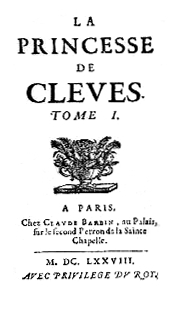
Mon édition de La Princesse de Clèves

lördag 5 mars 2011

"the eternal rocks beneath"

I haven't finished my series about Emma, but I feel an urge for an interlude of more romantic qualities now, since I celebrated the anniversary of my wedding the other day. So this is a text written entirely for romantic reasons about a romantic novel intended for a romantic husband to read:

I often re-read novels. I know some people find that stupid, life is filled to the brim with interesting new acquantainces and novels to read so why re-read novels?

I say that there is no end to the number of books worth reading and people worth knowing in this cruel, crazy, beautiful world, but I am not an infinite person and since I cannot read all good books in the world during my life time, and I'm not going to meet all interesting people in this world before I die, I might as well discover those I happen to have close by, much deeper.

One of the novels I get back to is Wuthering Heights by Emily Brontë, an intriguing mixture of Flaubertian realism and romanticism of the most heart breaking, windswept kind. The story of Cathy and Heathcliff, two orphaned and abused children who find comfort in each other's company on the wily moors of Yorkshire. None of them is amiable or charming, on the contrary, they are selfish and rude as are most of the characters in this breath taking novel.


One passage of the book that comes to my mind when I'm thinking about my marriage and husband is when Cathy says about Heathcliff :

”If all else perished and he remained I should still continue to be; and if all else remained, and he was annihilated, the universe would turn to a mighty stranger. I should not seem a part of it.[...] My love for Heathcliff resembles the eternal rocks beneath — a source of little visible delight, but necessary. Nelly, I am Heathcliff – he's always, always in my mind – not as a pleasure, any more than I am always a pleasure to myself – but as my own being — so, don't talk of our separation again.”

Although my husband is of great pleasure to me, all the rest fits in perfectly. We met each other when we both were young, we are «high school lovers», and we have shared the toils and tribulations of life together. When I look upon his dear face I see myself, or at least one part of me– the best one – at the same time as I see a person that I don't know half as well as I would wish to. I know there still remain depths to be discovered deep down below his lovely surface — «the eternal rocks beneath».

Kate Bush

Here is ” Wuthering Heights” with Kate Bush for you, husband, friend and lover (she dances like me, don't you agree?):